


What Austin Homeowners Are Learning to Check Before Hiring an Out-of-Town Roofer

Every spring, hail rolls through Central Texas and, within days, unfamiliar trucks show up in neighborhoods across Austin, Round Rock, and the surrounding suburbs. Crews knock on doors offering “free inspections” and same-week repairs. Homeowners…
AIHW Gum Disease Data Shows the Real Divide Isn’t Age, It’s Access

New analysis from the Australian Institute of Health and Welfare puts a number on something dentists have long observed anecdotally: roughly 1 in 10 Australian adults aged 18 and over reported having gum disease in…
What the New Metals Tariffs Are Doing to Steel Costs on 2026 Industrial Job Sites

Anyone pricing a steel-framed building this year has noticed the same thing: the number on the quote keeps moving up. The 2026 round of tariffs on imported steel, aluminum, and copper has pushed raw material…
What 396 Singapore Wedding Banquet Packages Reveal About the Price Traps Couples Keep Missing

Ask ten newly engaged couples in Singapore how much a wedding banquet costs, and you’ll get ten different answers — most of them wrong by a wide margin. A 2026 analysis by wedding planning platform…
Why Las Vegas Backyards Are Winning the Renovation Budget Over Kitchens in 2026

For decades the kitchen was the trophy room of any renovation. Granite, an island the size of a small boat, cabinets that cost more than a used car. The kitchen said you’d arrived. That order…
It Took Google 18 Years to Give Android Tablets a Feature Chrome Desktop Launched With

Chrome for desktop has had a bookmarks bar since the browser’s first release. Chrome for Android — on the phone that’s in more pockets than any desktop is on any desk — didn’t get one…
What the March 2026 Building Code Exam Switch Means for Toronto Roofing Contractors

There was a small, technical milestone in spring 2026 that says something larger about who is qualified to work on your roof. It will not make headlines, but it is a useful lens on contractor…
How the Gulf Desalination Boom Is Driving Demand for Corrosion-Resistant Stainless Plate

Some of the most demanding corrosion environments on earth are not in chemical plants or offshore platforms. They are in the desalination facilities turning seawater into drinking water along the coastlines of the Middle East,…
SSA Says Its Disability Backlog Is Shrinking. Arizona Applicants Tell a Different Story

The Social Security Administration would like you to know its numbers are improving. In an official update, the agency reported that its initial disability claims backlog had fallen to roughly 831,000 cases, down about a…
How the 2026 Water Supply Picture Is Reshaping Tropical Yards Across San Diego County

Tropical-style landscaping has an image problem in a dry state: lush foliage looks thirsty. The reality in 2026 is more interesting, and it starts with the numbers coming out of the state’s water managers. By…
– You can also use the “Add
What Austin Homeowners Are Learning to Check Before Hiring an Out-of-Town Roofer
Every spring, hail rolls through Central Texas and, within days, unfamiliar trucks show up in neighborhoods across Austin, Round Rock, and the surrounding suburbs. Crews knock on doors offering “free inspections” and same-week repairs. Homeowners rarely get a chance to ask where the company is actually based before a contract lands on the hood of a car.
Some of these crews are legitimate businesses expanding temporarily into a hail-affected market. Others exist for one purpose: collect insurance-backed deposits in a damaged neighborhood, do minimal or substandard work, and leave before anyone can follow up. That’s hard to tell in the moment, and the difficulty is exactly what the industry term “storm chaser” describes.
That gap shows up again and again in consumer complaints filed after major storms. Roofing is one of the few trades where a contractor can operate for weeks with no fixed local address, no permanent phone number, and no way for a customer to find them again once the check clears.
Texas lawmakers tried to close part of that gap in 2025. House Bill 3344 would have created a state licensing system for reroofing contractors, requiring applicants to disclose a residential or business address and list that contact information directly in written contracts. The bill died in committee before reaching a floor vote. Texas still has no dedicated statewide license for roofers.
The Legal Gap That Lets Unregistered Crews Work Neighborhoods for Weeks
Without a statewide licensing requirement, roofing remains one of the least regulated major home-repair trades in Texas. Cities can require permits for the work itself, but nothing stops a two-person crew from another state setting up in a parking lot and canvassing a hail-damaged subdivision.
Storm-chaser complaints often follow a recognizable pattern: quick solicitation after a storm, pressure to sign, a large deposit, and difficulty reaching the contractor later. That pattern is why consumer agencies urge homeowners to verify a business before paying.
By the time a shingle fails or a flashing detail leaks months later, the phone number on the invoice is disconnected. No local office to visit. No way to confirm the business ever had one.
HB 3344’s failure left the current vetting system unchanged. Until Texas adopts a roofing-specific licensing framework, homeowners have to verify several separate business and contractor signals themselves.
Roofing isn’t entirely unregulated in Texas, to be fair. Building codes still require permits for reroofing work in most municipalities, and permit records can offer homeowners a partial paper trail. But a permit confirms that paperwork was filed for a job, not that the company pulling it has any lasting connection to the community where the work is being done.
Why State Officials Keep Pointing Back to the Same Basic Checks
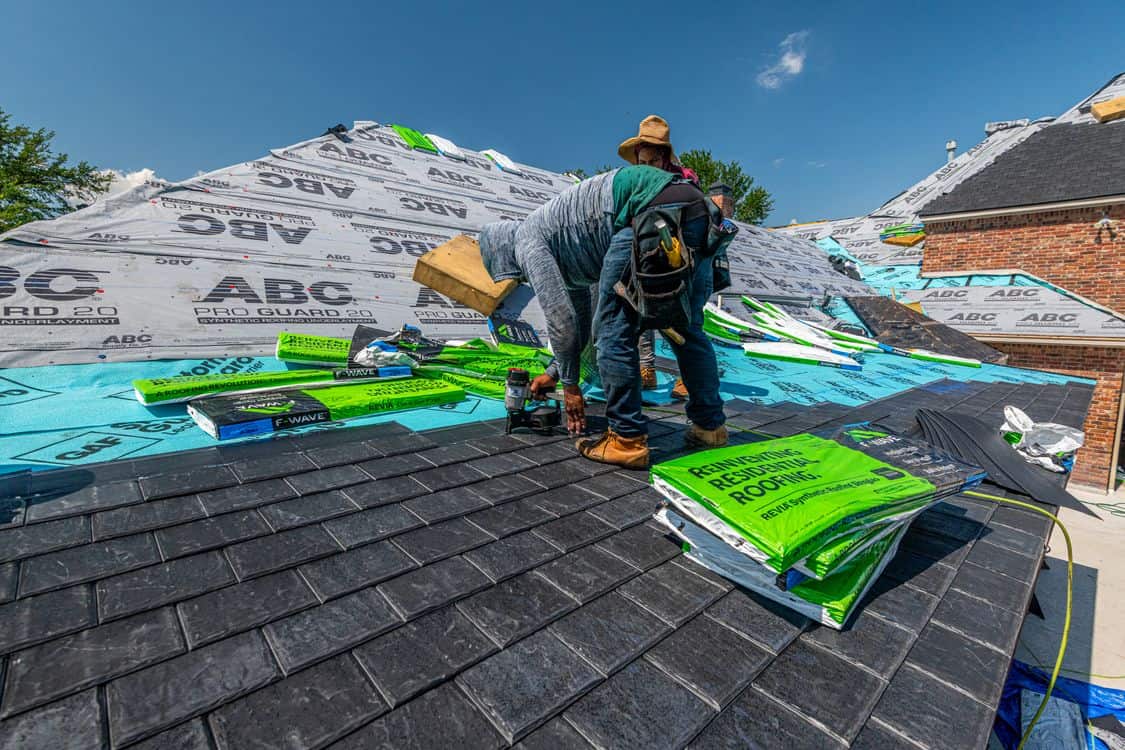
The Better Business Bureau’s Texas chapters have issued the same warning after nearly every major storm event in recent memory, urging residents to slow down before signing repair contracts. The advisories tend to follow damage geographically, appearing within days of whichever region just got hit.
One instruction shows up in nearly every version of that advice. After Central Texas severe weather, the BBB has specifically warned residents to be wary of unfamiliar contractors going door to door, since itinerant crews are harder to hold accountable once storm season ends and they’ve moved on to the next market.
Central Texas hail events can attract traveling crews alongside established local companies, which is why the same post-storm vetting advice remains relevant in Austin-area neighborhoods.
The Attorney General’s office flags a related issue. Texas price-gouging law bars vendors from charging excessive prices for essential repairs after a governor’s disaster declaration, but that protection only works if a homeowner can identify who they contracted with in the first place.
Post-storm complaints often involve pressure to sign quickly, deposits paid before a company is fully vetted, and difficulty resolving problems later. Clear contracts and independently verified business information reduce that risk.
The Verification Steps Homeowners Are Adding to Their Process
Before signing a roofing contract, homeowners can confirm the company’s legal business identity, physical contact information, insurance, local history, and references. A fixed local presence is useful, but it should be verified through records rather than judged from one piece of contact information. An established Austin roofing company should have business information that can be independently cross-checked after a storm, not just a temporary phone number and sales pitch.
A local landline is not a meaningful modern requirement by itself. Many legitimate contractors use mobile or cloud-based phone systems. More useful checks are whether the business name, address, insurance, permits, and references can be independently verified.
The pressure to vet quickly is highest after a storm, which is exactly when homeowners benefit from slowing down long enough to confirm those basic details.
None of this eliminates risk entirely, and Central Texas will keep drawing storm-chasing crews as long as hail keeps falling on a region that adds rooftops every year. Homeowners who verify a fixed, longstanding local presence before signing anything are doing, informally, what HB 3344 tried and failed to make mandatory.
AIHW Gum Disease Data Shows the Real Divide Isn’t Age, It’s Access
New analysis from the Australian Institute of Health and Welfare puts a number on something dentists have long observed anecdotally: roughly 1 in 10 Australian adults aged 18 and over reported having gum disease in 2021, a figure that climbs to about 15% among those aged 55 to 74.
Age is only part of the story, though. The same data shows adults eligible for public dental care had an inadequate dentition rate — fewer than 21 teeth — of 24%, compared with just 4.7% among those ineligible for public care. That’s roughly a five-fold gap driven by access to care rather than biology.
Tooth loss patterns follow the same divide. In the most recent detailed figures, adults averaged 4.4 missing teeth due to decay and periodontal disease, with those on lower incomes and lower education levels showing roughly double the missing-teeth rate of more educated cohorts.
Local general practices such as The Smile Designer Melbourne have started referencing figures like these in patient conversations, arguing that consistent attendance matters more to long-term outcomes than any single demographic factor.
Check-Up Habits Change the Outcome More Than Anything Else
One of the more striking findings buried in the report: adults who typically only see a dentist when something’s already wrong were about twice as likely to report gum disease (18%) as those who attend for routine check-ups (8.7%).
That’s not a subtle difference. It suggests the biggest single lever on long-term oral health outcomes isn’t income or age bracket on its own, but whether someone has a standing relationship with a practice they visit before problems start.
Patients who treat dental visits as reactive, booking only once pain or visible damage forces the issue, are effectively selecting into the higher-risk group the data describes, regardless of what they can afford.
What Preventive-First Practices Are Doing Differently

Clinics built around a check-up-first model tend to catch gum disease and early decay before restorative work becomes necessary, which is a meaningfully cheaper and less invasive path for the patient over time.
That model depends on continuity. The same clinician tracking changes in a patient’s mouth over several years notices things a one-off visit won’t, which is part of why regular attenders in the AIHW data fare so much better than reactive ones.
In practice, that means the choice of dentist matters less for the emergency visit than it does for the years of check-ups before an emergency would ever happen.
Turning the Data Into a Practical Decision
None of this is abstract for someone deciding where to book a check-up in Melbourne’s inner north. The AIHW numbers make a reasonably strong case that consistent, preventive attendance at one practice outperforms occasional visits to whichever clinic has next-day availability.
For residents comparing options, a preventive-first general practice in the area has built its offering around exactly that model: recall appointments, hygiene monitoring, and early intervention rather than purely reactive treatment.
Given how clearly the data separates outcomes by attendance pattern rather than age or income alone, that structural difference in how a practice is run may matter more to long-term oral health than any single procedure choice.
The five-fold difference in inadequate dentition rates between those eligible and ineligible for public dental care is one of the starker figures in the entire report. It suggests access, not awareness, is the primary driver of poor outcomes in the lower-income cohort.
That has implications beyond public policy. It means private practices positioned to offer flexible payment structures or staged treatment plans are effectively lowering the same access barrier the AIHW data identifies, even if that’s not how the practice would describe its own pricing model.
It also reframes what “affordable dentistry” should mean in practice. Cheap one-off treatment is less valuable, on this data, than a payment structure that supports someone attending twice a year for a decade.
Source: around twice as many adults who visit only for problems report gum disease compared with regular check-up attenders.
What the New Metals Tariffs Are Doing to Steel Costs on 2026 Industrial Job Sites
Anyone pricing a steel-framed building this year has noticed the same thing: the number on the quote keeps moving up. The 2026 round of tariffs on imported steel, aluminum, and copper has pushed raw material costs into territory general contractors haven’t budgeted for since the early pandemic years. The ripple effects are landing hardest on projects that were already penciled tight.
The pain isn’t evenly distributed. Residential builders have absorbed some of the shock by substituting materials or delaying non-structural finishes. Industrial and commercial builders don’t get that option. Columns, beams, trusses, and bracing are load-bearing, and there’s no cheaper substitute for structural steel when the design calls for a 60-foot clear span or a crane-rated frame.
The housing sector numbers tell the bigger story
A Brookings Institution estimate cited by construction industry analysts puts a hard figure on the damage. The tariffs could add roughly $17,500 per new home, once steel, aluminum, and copper pricing work through a typical build. That number comes from residential construction, but it’s a useful proxy for the industrial side, where steel is a much larger share of total material cost per square foot.
For a warehouse, a multi-story industrial frame, or an equipment platform, the steel line item is often the single largest cost on the estimate. Move that line 15 to 20 percent in a matter of months and a budget that looked comfortable in January can look underfunded by summer.
Owners and general contractors have responded by locking in mill orders earlier, sometimes before final structural drawings are even complete. That’s new. Fabrication timelines used to allow for late-stage design changes without blowing the material budget. Now they don’t.
Fabrication coordination becomes a cost lever
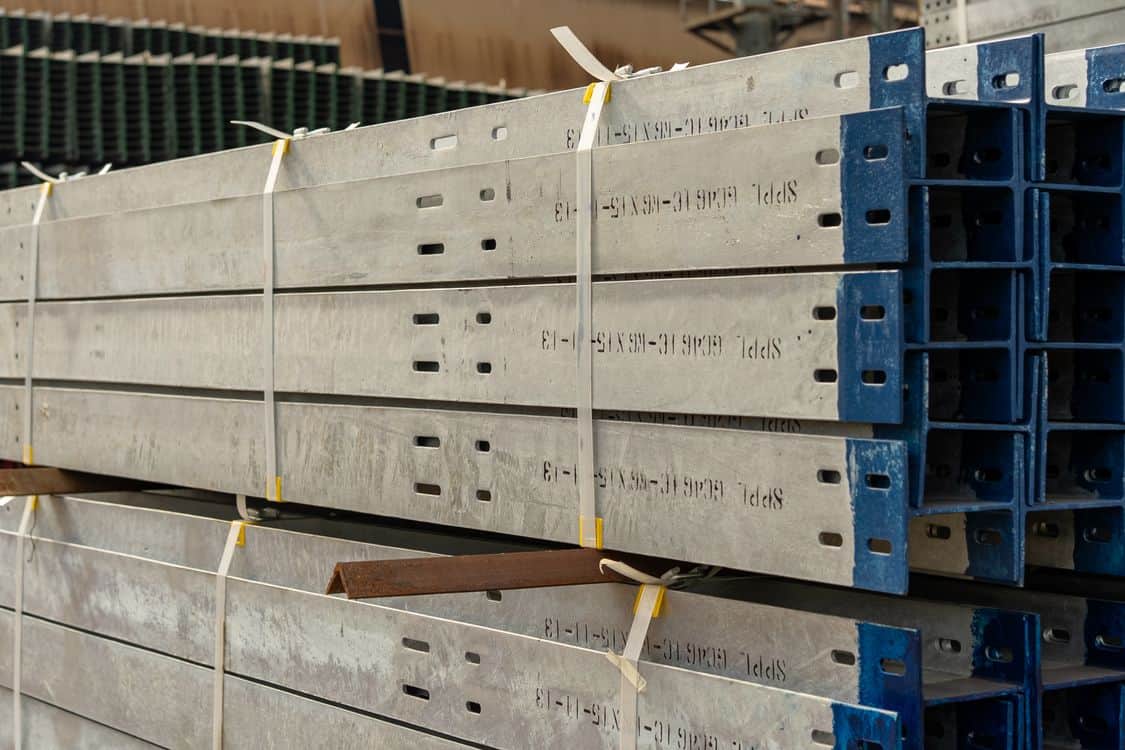
Raw material pricing is out of anyone’s control right now, so the parts of the process that remain controllable are getting more attention: connection design, fabrication sequencing, how much of the assembly work happens in the shop versus the field.
Bolted connections, torsion-shear high-strength bolts, and pre-fit trial assemblies reduce field labor hours. That matters more when every other line item is inflated. Projects that coordinate fabrication details early, before cutting and drilling begin, tend to avoid the rework that used to be a rounding error and is now a real budget risk.
Surface treatment decisions matter too. Galvanizing costs more upfront but extends service life in exposed industrial environments, and with prices this volatile, owners are paying for durability now rather than risk a full material re-order in a decade.
Long-span and multi-story projects feel it more
Sports facilities, aircraft hangars, distribution centers. These lean on larger, heavier structural members where the tonnage adds up fast. A truss system or space-frame roof spanning a clear 100 feet uses substantially more steel per square foot than a conventional column-and-beam layout, so tariff-driven price increases hit those designs harder.
Multi-story industrial frames carry a related but different pressure. Vertical load transfer through H-sections and box columns compounds the tonnage question with height. A four-story frame doesn’t just need more steel than a single-story building of the same footprint; it needs steel rated for cumulative loads, which usually means higher-grade material at a higher price per ton.
Engineers coordinating overseas projects have flagged another wrinkle. Sourcing decisions now carry real financial consequences they didn’t two years ago. A project team weighing domestic versus imported structural steel has to run the tariff math alongside the usual lead-time and quality considerations, and the answer isn’t always what it would have been in 2024.
None of this resolves quickly. Trade policy moves on political timelines, not construction timelines, and most industry forecasts through 2027 assume elevated steel pricing as the new baseline. Lock in pricing early, coordinate fabrication details before cutting starts, and budget for a material line item that behaves less predictably than it used to.
The old model of industrial steel procurement assumed a fairly stable window between design finalization and mill order. Contractors could wait for structural drawings to firm up, collect competitive bids from several fabricators, and place orders with a reasonable expectation that pricing wouldn’t move much in the interim. Not anymore. Project teams that wait for full design certainty before locking in steel pricing are betting the market won’t move against them, and this year that’s been a bad bet more often than not.
Some general contractors have started building tariff-contingency line items directly into early-stage budgets, a practice that was rare before 2025. Owners feel this shift too, particularly on design-build projects where the contractor absorbs some of the material price risk. Contracts that used to lock in a guaranteed maximum price early in design are increasingly including escalation clauses tied to steel and metals indices, a hedge that protects contractors but shifts schedule pressure onto owners.
For years, sourcing decisions on structural steel were driven mostly by lead time and price, domestic and imported material treated as reasonably interchangeable depending on which was cheaper that quarter. Tariff policy reintroduced a variable that hadn’t mattered much in over a decade: country of origin as a direct cost driver, independent of quality or lead time. A supplier relationship that made sense in 2023 might not pencil out the same way in 2026, purely because of where the raw material originates.
What 396 Singapore Wedding Banquet Packages Reveal About the Price Traps Couples Keep Missing
Ask ten newly engaged couples in Singapore how much a wedding banquet costs, and you’ll get ten different answers — most of them wrong by a wide margin. A 2026 analysis by wedding planning platform Vows.sg, drawn from 396 wedding package singapore listings across 115 venues, put real numbers behind the guesswork.
The spread is enormous. Per-table pricing ranges from S$498 at a vegetarian restaurant in Leng Kee to S$4,292 at a Sentosa resort designed by Norman Foster. Most couples land somewhere in the middle, but the gap between quoted price and final bill is where the real surprises happen, and it’s a gap that catches even couples who think they’ve done their homework.
What makes the dataset useful isn’t the extremes — it’s the middle. Once 396 packages are laid side by side, patterns emerge that are almost impossible to see when a couple is only comparing the three or four venues they happened to visit in person.
Where Most Couples Actually Land
According to the breakdown, 33 percent of the 396 tracked packages fall into the S$1,200 to S$1,800 per table bracket — the single largest segment of the market. Budget options under S$1,200 make up another 24 percent, while premium packages between S$1,800 and S$2,500 account for 28 percent.
Only 8 percent of venues sit above S$2,500 a table, a tier reserved for properties like Raffles Hotel, Capella Singapore, and Marina Bay Sands. The median across the full dataset sits around S$1,500 per table before service charge and tax, which for a typical 20-table wedding works out to roughly S$30,000 before any surcharges are applied.
The mid-range tier tends to include a fairly consistent set of inclusions: a 10-course dinner, a complimentary wedding suite for one night, basic table centrepieces, and parking for roughly one car per table. Premium and luxury tiers add dedicated wedding planners, elaborate floral arrangements, and — at the very top end — bespoke menu customisation and premium liquor packages.
The budget tier tells its own story about where couples can genuinely save without compromising the experience. Heritage Chinese restaurants like Spring Court, operating in Chinatown since 1929, sit at S$888 a table with none of the hotel markup — proof that a lower price point doesn’t automatically mean a lower-quality banquet, just a different kind of venue entirely.
The Surcharge Most Couples Forget to Budget For

The figure that trips up the most couples isn’t the headline price at all. It’s the “++” symbol sitting quietly next to it, a detail easy to skim past when a couple is comparing a dozen quotes at once.
Service charge and GST together typically add close to 20 percent to a quoted table price. A table listed at S$1,500 becomes roughly S$1,798.50 once both are applied — and across a 20-table wedding, that gap alone works out to nearly S$6,000 that many couples never see coming until the final invoice arrives.
Some venues, more often independent Chinese restaurants than hotels, quote nett pricing instead. The analysis found this distinction alone can shift a couple’s effective budget by thousands of dollars, depending purely on which type of venue they choose — a variable that has nothing to do with food quality or service standard, and everything to do with how the venue structures its billing.
Beyond service charge and GST, the data flagged a longer list of costs that rarely appear on the headline quote: corkage fees running S$25 to S$50 a bottle, peak-period surcharges of S$50 to S$200 a table on Saturdays and auspicious dates, and overtime charges that can run S$500 to S$1,500 an hour for events pushing past midnight.
Negotiating Room Still Exists
Despite the scale of the market, couples aren’t entirely at the mercy of list prices. Venue managers rarely discount the per-table rate directly, since it looks bad on paper, but they will often add extras instead — upgraded menu courses, a complimentary wine package, or an extended wedding suite stay.
Timing matters just as much. Weekday dinners and Sunday lunches can run S$100 to S$300 cheaper per table than a Saturday evening slot, a gap that adds up quickly across a full guest list — for 20 tables, that’s a potential S$6,000 in savings from a date change alone.
Booking early carries its own financial logic. Banquet prices in Singapore typically rise 3 to 5 percent a year, so locking in a rate 12 to 18 months ahead of an event can save a meaningful sum on a large guest list, even before any active negotiation begins.
With 396 packages now mapped across the market, the days of couples negotiating blind are largely over — the harder part is simply knowing which questions to ask before signing.
Even at the negotiating table, the fundamentals rarely change: a couple who walks in knowing where their target venue sits within the broader 396-package dataset has a materially stronger position than one relying on a single quote in isolation.
The minimum table guarantee is another lever worth understanding before negotiations even start. Most venues require 15 to 25 minimum tables, and couples with a smaller guest list can sometimes negotiate that threshold down, or convert unused table capacity into a drinks package or room upgrade instead of paying for tables that will sit empty.
Why Las Vegas Backyards Are Winning the Renovation Budget Over Kitchens in 2026
For decades the kitchen was the trophy room of any renovation. Granite, an island the size of a small boat, cabinets that cost more than a used car. The kitchen said you’d arrived.
That order is wobbling. The home-improvement data coming out of 2025 and into 2026 shows homeowners moving real money outdoors, and not as a consolation prize. The backyard has become a serious contender for the renovation dollar, and in a place like Las Vegas the logic gets especially sharp.
When your climate hands you long warm seasons and short mild winters, an outdoor room isn’t seasonal. It’s square footage you actually use most of the year, which is exactly the kind of value that changes how a budget gets split.
What the cost-versus-value numbers actually say
The resale case for outdoor work has gotten stronger, not weaker. Industry tracking puts a new patio among the better recovery rates in remodeling, with national figures showing homeowners recover roughly 95% of the cost of a patio at resale.
That number reframes the whole decision. A kitchen remodel can run deep into five figures and still recover a fraction, while a well-built outdoor space returns most of what you put in and hands you a usable room in the meantime.
Roofing over an existing patio sits in a similar zone. The cost to add a cover is a fraction of a major interior project, and it converts a sun-baked slab into a real extension of the house. Dollars per usable square foot, the outdoor option wins in a way it simply didn’t a generation ago.
Buyers have caught on. Surveys of recent homebuyers keep putting outdoor living near the top of the wish list, so a finished, covered patio reads as a selling feature now instead of a quirky bonus.
Why the backyard wins in a desert market
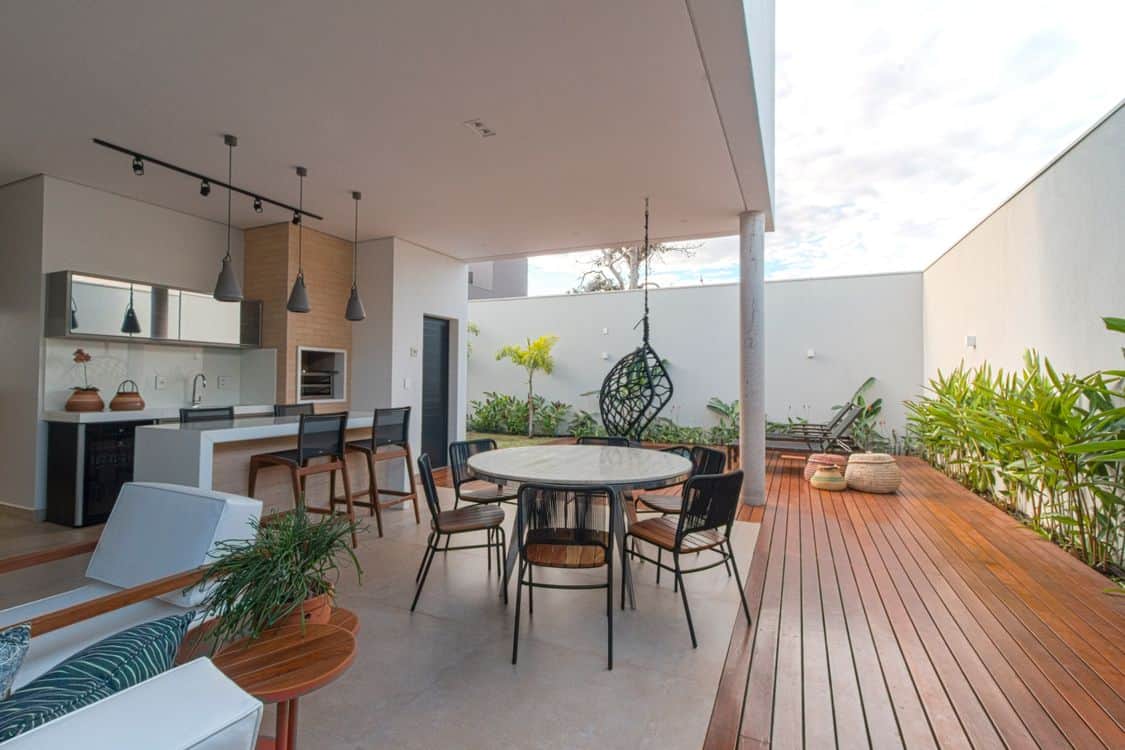
The national trend has a local accelerant. In Las Vegas the inside of the house spends a chunk of the year as a heat refuge, but the backyard can be engineered into a genuinely pleasant place with the right shade and airflow.
That shifts the value math. A covered patio in the Midwest might be a three-season feature. In Southern Nevada, with a solid roof and a couple of fans, it stretches toward year-round use, so the investment gets spread across far more days of actual use.
There’s a scarcity angle too. Lots in newer valley developments keep shrinking, and interior square footage is at a premium. Turning wasted backyard into a covered room is one of the only ways to add livable area without a full addition and the permit headache that comes with it. For a lot of households weighing a kitchen refresh against an outdoor build, the outdoor build now offers more usable life per dollar.
From statement piece to daily use
The motive behind these projects has matured. The trend reports describe a move away from look-at-me amenities toward spaces built around actual daily habits: the morning coffee spot, the shaded reading corner, the place to eat dinner without heating up the house.
Practicality is the new luxury. People are spending on shade, comfort, and durability instead of on features that photograph well and then sit unused. A patio cover fits that perfectly, because its whole job is to make the space reliably usable.
Which is also why covered outdoor rooms are pulling budget away from purely cosmetic interior upgrades. A new backsplash is nice. A shaded outdoor living room you use four hundred times a year is a different category of thing.
The kitchen isn’t going anywhere, of course. It’ll always take a share of the renovation budget. But the assumption that it automatically deserves the biggest share is breaking down, and in warm-climate markets the backyard is the reason. For a Vegas homeowner running the numbers, the covered patio has quietly stopped being the project you do after the important work is done.
It Took Google 18 Years to Give Android Tablets a Feature Chrome Desktop Launched With
Chrome for desktop has had a bookmarks bar since the browser’s first release. Chrome for Android — on the phone that’s in more pockets than any desktop is on any desk — didn’t get one until 2026, and even now, only on tablets and foldables.
It’s a small feature, arriving very late, framed as a big deal.
What Actually Shipped
Starting with Chrome version 146 for Android, a bookmarks bar now sits directly below the address bar on larger-screen devices, mirroring the desktop layout down to the details: favicons next to site names, folder support, and a long-press on any bookmark that reveals its full URL. On phones, the feature stays hidden — this update is scoped specifically to tablets and foldables.
Turning it on takes a trip to Settings, then Appearance, then selecting “Show bookmarks bar.” Google positioned the rollout as bringing Chrome on Android closer to the desktop experience, which is a fair description — it’s also an acknowledgment of exactly how long that gap existed.
The Real Story Is How Long the Gap Was Allowed to Sit

Chrome commanded 70% share of the browser market by the end of 2025, and a large share of that usage happens on Android. That a feature this basic — quick access to saved sites without digging through a menu — took the better part of two decades to reach Android’s larger-screen devices says something about how bookmarks get deprioritized relative to whatever the current roadmap priority is.
It’s not hard to guess why phones weren’t included in this rollout either: screen real estate is scarcer, and a persistent bar competing with the address bar and tab strip is a harder design problem there. But that’s a reason for a later phone rollout, not a reason the tablet version took this long to exist at all.
Where This Leaves Other Mobile Browsers
Samsung Internet, the default browser on Galaxy devices, has offered bookmark sharing on its start page for years, independent of Chrome’s development timeline — one of the small differentiators that’s helped it hold onto users who might otherwise default to Chrome. Firefox for Android has similarly offered pinned Top Sites tiles as a bookmark-adjacent quick-access row well before this Chrome update. Chrome’s tablet rollout is closing a gap against its own desktop version more than it’s catching up to competing mobile browsers, several of which solved a version of this problem independently.
A Feature Arriving Late Is Still Only Half the Story
Getting a bookmarks bar on Android tablets is a genuine, welcome quality-of-life improvement for anyone who’s been stuck navigating Chrome’s mobile bookmarks menu one tap at a time. But it only solves visibility within Chrome itself — it does nothing for the person switching between Chrome on their tablet, Safari on their phone, and Edge on their work laptop, all with different sets of saved sites.
What the March 2026 Building Code Exam Switch Means for Toronto Roofing Contractors
There was a small, technical milestone in spring 2026 that says something larger about who is qualified to work on your roof. It will not make headlines, but it is a useful lens on contractor credibility in the GTA.
The change concerns the people who design, inspect, and sign off on building work, and it filters down to the trades through the standards they are held to. For a homeowner, it is a reminder that roofing is a regulated trade with real qualifications behind it.
The quiet milestone
As of late March 2026, the province’s building-code certification exams switched to the 2024 edition, and the restructured regulation now adopts the National Building Code of Canada 2020, with Ontario-specific amendments layered on top.
In plainer terms, the officials and designers who administer the building system are now being tested against the current code, not a decade-old one. The whole apparatus has formally moved forward to the newer rulebook.
Why a homeowner should care
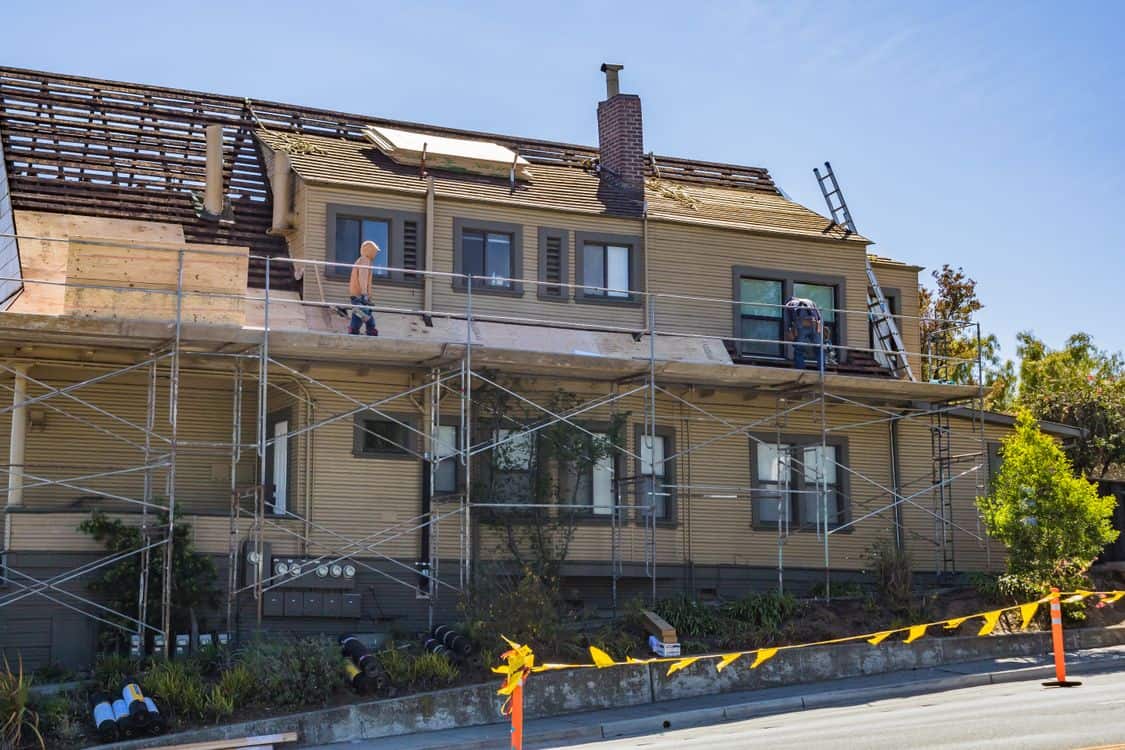
The exam change is aimed at professionals, but it shapes the environment a roofing contractor works in. A roofer operating today is building inside a system that has updated its standards, its documentation expectations, and its inspection criteria.
That makes a contractor’s comfort with the permit and inspection process a genuine signal of quality. A roofer who pulls permits without complaint, passes inspection cleanly, and keeps proper records is one working inside the system rather than around it. The ones who treat permits as an obstacle to dodge are telling you something too.
The credibility markers that follow from it
Code currency is one of several things that separate an established roofer from a fly-by-night crew, and the others are worth restating because they travel together. Proper liability insurance protects you if something goes wrong on your property. A current WSIB clearance certificate means the workers on your roof are covered, so a workplace injury does not become your problem.
Written warranties on both materials and workmanship give you recourse if the roof fails early. And a real business address and verifiable history mean the company will still exist if you need to call it in five years. The firms that survive that kind of scrutiny tend to carry the full set, which is exactly why the checklist is worth running before you sign.
A regulated trade, not a handshake
The exam switch is ultimately a small reminder of a big point: roofing is a licensed, regulated, inspected trade, not a cash-and-handshake business done off the back of a truck. The contractors who operate that way, with insurance, clearances, permits, and warranties, are the ones a homeowner can hold accountable.
So when you are comparing quotes, look past the price to the paperwork. A roofer who is current on the code, properly insured, and willing to put warranties in writing is offering something the lowest bidder usually cannot: a roof you can stand behind, and a company that will stand behind it.
How the Gulf Desalination Boom Is Driving Demand for Corrosion-Resistant Stainless Plate
Some of the most demanding corrosion environments on earth are not in chemical plants or offshore platforms. They are in the desalination facilities turning seawater into drinking water along the coastlines of the Middle East, and they are multiplying fast.
That expansion is a steady, often overlooked source of demand for corrosion-resistant stainless, because seawater is merciless to the wrong material.
A water crisis is rewriting Gulf infrastructure
The scale of investment is hard to overstate. Saudi Arabia alone has poured roughly $80 billion in new projects into desalination, lifting its capacity toward 8.5 million cubic metres per day and making it the world’s largest producer of desalinated water.
It is not alone. The UAE, Kuwait, Bahrain, and others are on track to more than double their desalinated water production by the end of the decade as freshwater scarcity bites.
Each of those plants is a dense assembly of pumps, piping, pressure vessels, heat exchangers, and structural supports, much of it in contact with seawater or hot brine. That is a corrosion problem first and an engineering problem second.
The material chosen for those components is what stands between a plant and premature failure in one of the harshest service environments going.
Why molybdenum changes the equation

Standard austenitic stainless handles a lot of environments well, but high-chloride seawater is where it starts to struggle with pitting and crevice corrosion. The fix is molybdenum.
Adding two to three percent molybdenum to an 18-8 austenitic base sharply improves resistance to chloride attack. That single change is what separates the marine-and-chemical grade from the general-purpose one.
This is the role a 316 stainless steel plate plays across a desalination facility. Its molybdenum content makes it the workhorse for the many seawater-wetted and splash-zone components where general-purpose stainless would pit and fail.
There are limits, and good engineers respect them. The hottest, most concentrated brine streams often push past what a standard molybdenum-bearing grade can handle, and those sections step up to duplex or super-austenitic alloys.
But across the broader plant, the molybdenum-alloyed grade hits the balance of corrosion resistance, availability, and cost that keeps a project buildable.
What the trend means for stainless buyers
For anyone supplying stainless plate, the desalination wave is a reminder that some of the strongest demand sits in unglamorous infrastructure rather than headline industries.
Water security has become a national-strategy issue across the Gulf, which means these projects carry political momentum and long planning horizons. That makes the demand more durable than a typical construction cycle.
It also rewards suppliers who understand the application. A desalination buyer is not just looking for a grade name on a certificate. They are looking for consistent corrosion performance, reliable documentation, and material that will survive decades in seawater service.
The geography is widening, too. Water scarcity is pushing large desalination projects into North Africa and beyond, spreading the same materials demand across new markets.
The Gulf turned to the sea for its drinking water out of necessity, and corrosion-resistant stainless is one of the quiet reasons that strategy holds together. As the rest of a thirsty world follows, the demand for molybdenum-bearing plate is likely to follow with it.
SSA Says Its Disability Backlog Is Shrinking. Arizona Applicants Tell a Different Story
The Social Security Administration would like you to know its numbers are improving. In an official update, the agency reported that its initial disability claims backlog had fallen to roughly 831,000 cases, down about a third from its peak.
On paper, that is real progress. On the ground in Arizona, many applicants describe an experience that does not match the press release.
Both things can be true at once, and understanding why is useful for anyone about to file.
The Difference Between a Backlog and Your Case
A national average hides enormous variation. A backlog can drop overall while specific offices, regions, and stages of the process stay jammed.
The initial-claims number the agency highlights is only the first step. After most initial denials comes reconsideration, then a hearing, and those later stages have their own queues that a “claims backlog” figure does not capture.
So an Arizonan can hear that the backlog is shrinking and still wait many months for a hearing, because the part of the pipeline they are stuck in is not the part the headline measured.
Why Reported Progress and Lived Delay Coexist

There is also the question of how progress gets measured. The agency has reduced how much performance data it releases publicly, which makes the improvements it does announce harder to independently check.
When the visible metrics shrink and the remaining ones look good, a gap opens between the official story and the applicant’s inbox. Advocates have pointed to exactly this gap: cheerful top-line numbers next to people who still cannot get a call returned.
For Arizona, where initial approval rates already run below the national average, an improving national backlog offers little comfort if your local odds and your local wait have not budged.
What to Do When the Stats and Your Reality Diverge
The lesson is not to disbelieve every number. It is to plan around your situation rather than the headline.
Assume your case will take longer than the optimistic figure suggests. Build that assumption into your finances and your patience. And use the waiting time to make sure your claim is airtight rather than hoping speed will rescue a weak file.
Part of an airtight claim is filing for the correct program. SSDI and SSI move through overlapping queues, but they pay differently and treat retroactive benefits differently, so a misfiled claim wastes the very time the backlog is already eating.
The agency’s numbers may keep improving. Your individual case will still rise or fall on its own merits and its own paperwork. For Arizonans, that is the figure worth focusing on.
How the 2026 Water Supply Picture Is Reshaping Tropical Yards Across San Diego County
Tropical-style landscaping has an image problem in a dry state: lush foliage looks thirsty. The reality in 2026 is more interesting, and it starts with the numbers coming out of the state’s water managers. By late spring, the Department of Water Resources had raised the State Water Project allocation to 45 percent of requested supplies, up from 30 percent earlier in the year.
An allocation moving up is good news, but the framing around it is the real signal. The increase followed a wet December that managers were careful not to oversell, with officials noting a dry January, limited northern Sierra snowpack, and Colorado River reservoirs still near historic lows. The message to Southern California was relief, not resolution.
For homeowners drawn to a tropical look, that mixed picture is shaping a smarter version of the style, one built to read lush while staying water-aware.
Why Tropical and Drought-Aware Are Not Opposites
The instinct that tropical means high water is half right. The look depends on bold foliage, layered heights, and a sense of fullness, but those visual cues do not all require thirsty plants. Much of the effect comes from leaf shape and arrangement, not from constant irrigation.
San Diego County’s Mediterranean climate, with its dry summers and mild winters, actually supports a long list of subtropical plants when they are placed correctly and grouped by water need. Palms add height and structure, bird of paradise delivers bold form in both coastal and inland yards, and species like ti plants and elephant ear supply the broad-leaf drama in the right microclimates.
The discipline is in the grouping. Hydrozoning, putting plants with similar water needs together, lets the thirstier specimens cluster where irrigation is efficient while the rest of the yard leans on low-water material. Done well, the eye reads a unified tropical scene; the water bill reads something far more modest.
Ground treatment carries some of the load, too. Mulch holds soil moisture, drip irrigation delivers water to roots instead of air, and surfaces like decomposed granite and stone keep paths cool without demanding a drop. These are not compromises to the look; they are the substructure that makes it sustainable.
Designing Around an Uncertain Supply

The state’s own posture, treating an improved allocation as temporary relief rather than an all-clear, is the right model for a homeowner planning a yard. The smart assumption is that water will be available but never to be wasted, and the design should hold up whether the next winter is wet or dry.
That argues for a backbone of plants that thrive on little, accented by a smaller number of higher-water statement specimens. A few well-placed palms or a single dramatic broad-leaf grouping can carry the tropical impression, while the surrounding planting stays lean. The contrast is what sells the style; you do not need the whole yard to be thirsty.
Water features follow the same thinking. The tropical vocabulary loves the sound of moving water, and recirculating systems, pondless waterfalls, wall fountains, and narrow basins, deliver that atmosphere while limiting waste. A feature that loops its water reads as lush without behaving like a leak.
Shade is the quiet multiplier. Pergolas, shade sails, and well-placed tall plants cut evaporation and reduce the heat stress on both people and plants, especially in the warmer inland parts of the county. A shaded planting bed simply needs less water than one baking in full afternoon sun.
What This Means for Homeowners This Year
For anyone planning a tropical-style project in San Diego County, the takeaway is not to abandon the look. It is to build it on a water-aware frame from the start, because retrofitting conservation into a thirsty design later is harder and more expensive than designing for it up front.
Start with the plant palette and the hydrozones, settle the irrigation method, and treat the highest-water elements as deliberate accents rather than the default. A yard built this way tends to stay healthier through dry stretches and looks intentional rather than stressed when restrictions tighten.
It is worth remembering that allocations and local rules can move in either direction from year to year, and a single agency figure is not a forecast for your own water district. Homeowners should confirm current local watering rules before committing to a planting plan, since those rules, not the statewide allocation, govern what happens in a given yard.
The larger pattern is clear enough, though. The tropical yards being built in the county now are quieter about their water use than the ones built a decade ago, and they look just as full. The style adapted to the climate, which is exactly what good landscape design is supposed to do.
Part of that adaptation is regional, too. A coastal yard near the ocean can lean on salt-tolerant species and layouts that welcome airflow, while an inland property contends with hotter afternoons that make shade and careful plant spacing more important. The same tropical vocabulary gets tuned differently depending on which part of the county a home sits in.
Long-term care is where these designs prove themselves. Slow-growing plant varieties, mulch to hold soil moisture, and irrigation grouped by need keep a mature tropical yard manageable rather than demanding. A scene that looks effortless after a few years is almost always one that was planned for low upkeep from the first day, not one that happens to stay lush by luck.
” button on the Page/Post Editor.
Shortcode using parameters:
What Austin Homeowners Are Learning to Check Before Hiring an Out-of-Town Roofer
Every spring, hail rolls through Central Texas and, within days, unfamiliar trucks show up in neighborhoods across Austin, Round Rock, and the surrounding suburbs. Crews knock on doors offering “free inspections” and same-week repairs. Homeowners…
AIHW Gum Disease Data Shows the Real Divide Isn’t Age, It’s Access
New analysis from the Australian Institute of Health and Welfare puts a number on something dentists have long observed anecdotally: roughly 1 in 10 Australian adults aged 18 and over reported having gum disease in…
What the New Metals Tariffs Are Doing to Steel Costs on 2026 Industrial Job Sites
Anyone pricing a steel-framed building this year has noticed the same thing: the number on the quote keeps moving up. The 2026 round of tariffs on imported steel, aluminum, and copper has pushed raw material…
What 396 Singapore Wedding Banquet Packages Reveal About the Price Traps Couples Keep Missing
Ask ten newly engaged couples in Singapore how much a wedding banquet costs, and you’ll get ten different answers — most of them wrong by a wide margin. A 2026 analysis by wedding planning platform…
Why Las Vegas Backyards Are Winning the Renovation Budget Over Kitchens in 2026
For decades the kitchen was the trophy room of any renovation. Granite, an island the size of a small boat, cabinets that cost more than a used car. The kitchen said you’d arrived. That order…
It Took Google 18 Years to Give Android Tablets a Feature Chrome Desktop Launched With
Chrome for desktop has had a bookmarks bar since the browser’s first release. Chrome for Android — on the phone that’s in more pockets than any desktop is on any desk — didn’t get one…
What the March 2026 Building Code Exam Switch Means for Toronto Roofing Contractors
There was a small, technical milestone in spring 2026 that says something larger about who is qualified to work on your roof. It will not make headlines, but it is a useful lens on contractor…
How the Gulf Desalination Boom Is Driving Demand for Corrosion-Resistant Stainless Plate
Some of the most demanding corrosion environments on earth are not in chemical plants or offshore platforms. They are in the desalination facilities turning seawater into drinking water along the coastlines of the Middle East,…
SSA Says Its Disability Backlog Is Shrinking. Arizona Applicants Tell a Different Story
The Social Security Administration would like you to know its numbers are improving. In an official update, the agency reported that its initial disability claims backlog had fallen to roughly 831,000 cases, down about a…
How the 2026 Water Supply Picture Is Reshaping Tropical Yards Across San Diego County
Tropical-style landscaping has an image problem in a dry state: lush foliage looks thirsty. The reality in 2026 is more interesting, and it starts with the numbers coming out of the state’s water managers. By…
Follow Us!


